

Topics Covered
Tags
Published on
Read time: 8 minutes
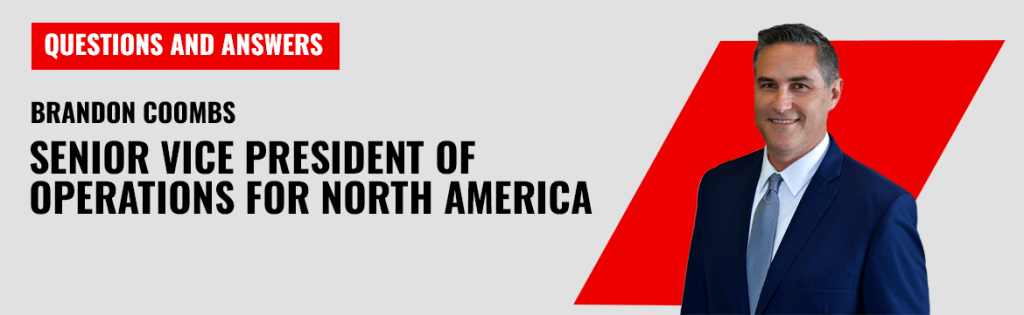
Brandon Coombs is Senior Vice President of Operations for North America at RS Integrated Supply. Coombs began his career in the supply chain and logistics industry more than 25 years ago, starting at ground level before moving into management roles. His vast wealth of experience and expertise has now been recognized with a 2026 Supply & Demand Chain Executive Pros to Know Leaders In Excellence award.
We sat down with him to learn more about his career, his insights into integrated supply, and his leadership philosophy. Here’s that conversation.
MRO Procurement Experience and End to End Supply Chain Insight
Thanks for your time today, Brandon, and congratulations on the Pros to Know award. What does winning mean to you?
Brandon Coombs: “It was unexpected to be honest. It’s both an honor and flattering to be recognized as a leader within this industry.”
“Absolutely. It seems as if these experiences come into play on a near daily basis, in addressing a variety of issues.
“Many things in common remain true, from the beginning of the journey to the present day. Albeit, certain aspects of the situation have changed, including how we manage it. However, the core issues are very similar, for example: being more efficient, leveraging key resources, maximizing productivity, reducing costs, driving P&L savings, etc. That’s why we’re here: we’re trying to optimize procurement and inventory strategies to maximize customer value.
“It can be quite complicated, because nearly every customer is in a different phase of maturity, so I like to think of it from the shop floor / end user experience. What material is needed? How urgent is the request? How do you know? How many parts? What’s the data like? How easy is it to identify the material needs? How do you know if it is critical or not? Where does one find the part? Is stock available? If not, why? Is the process efficient? Zooming out to the macro level for all of these details, it is important to consider how does this experience integrate into a larger strategy to mitigate risk and maximize productivity?”
The Future of Integrated Supply and Storeroom Management
“When thinking of the storeroom in the future, many elements have developed over the past few decades. Take vending machines, for instance. When I started my career, I was involved in the early implementations of industrial vending solutions with key aerospace customers. The concept was quite new, and customers were often ‘skeptical’ if it would work.
Also, the data was fragmented, often hosted in Local Area Networks (LAN, at a plant level, with different SKUs per plant and lacking the ability to share master data across the enterprise. I remember the excitement when we began migrating the data into a SQL [Structured Query Language] cloud-based platform and all the excitement about being able to see inventories across the plant level. However, the lack of clean master data and duplicate part information remained a big challenge in those days.
The same was true regarding legacy ERP/CMMS systems, many of those I recall using in those days lacked an enterprise view capability, being hosted again at a plant level. So, many things have improved over the past 25 years with cloud computing and AI, but fundamentally the mission is the same: Having the right materials near the point of use, in the right quantity, at the right time.
“The question now is how to leverage all the data we have: understanding what parts are needed, what’s critical, what are the lead times, and ensuring part availability is optimized within all the various constraints. With the various AI tools coming out, it’s going to be much quicker to solve these problems and no doubt there will be better enablement of lineside stocking solutions, and improved productivity as a result.
“I believe that is the future in this space. However, as in the past, there is still waste in the process to be extracted. This is why customers bring us in – to solve problems for them. Part of our vision at RS Integrated Supply is to leverage technology so we have visibility of materials across the whole process from the point of need to the point of consumption. Therefore, the challenge is: How do we manage getting the right part, at the right time, at the right price, in the most expeditious way?”
Standardization Strategies in MRO Supply Chain Management
“Because customers hire us to give them the best process experience, our aim is not to simply lift and shift the legacy process and keep it status quo, but to enhance that process through innovation, improvement, and value as a strategic business partner.
“Granted, there are variations as to how this may all come to fruition. In other words, it is quite complex, given the various customer requirements and constraints upon the processes. However, promoting, adopting, and scaling best practices is critical to success. We are often hired as an extension of our customer’s change management journey. At the core of this solution is our technology platform, which is designed to optimize both inventory and procurement solutions to maximize the value of our service.
“As an integrator, if we don’t take this approach, how do we differentiate our service offering? How do we know if we are satisfying the customer’s objectives, and so forth? Our goal is to deliver a high-value service that exceeds customer expectations. At the core, automation, efficiency, and scalability are critical to delivering the total value expected.
“In the long run, this drives more value so it’s engagement and longer-term partnerships that we seek. If we were just a low-cost leader, it would be more short-term engagement focused upon cost. Yes, our goal is to save customer’s money, however if that is our only focus without higher quality and service, customers are unlikely to be fully satisfied with the program at time of renewal. That is not a space we want to be in. So, longer term engagement, planning, and monitoring of the program with our customers is critical.”
Leadership and Culture in Integrated Supply Operations
“I’ve recognized it for most of my career but my appreciation for it has certainly grown over time in understanding the value and importance of culture as key success factor in our business.
“In leadership roles, it’s extremely important to create cohesion among your teams. That’s why people are willing to work for RS Integrated Supply. It’s not an easy job. It’s complicated, with lots of demands, often long and difficult hours, and it can be stressful, but there’s a lot of cohesion and camaraderie. That culture is part of what makes us special.”
“Growing and developing talent is a key part of this business. However, it can be quite challenging because we have a decentralized workforce, who are embedded at our customer facilities across many locations across the globe. Given the fast-paced business environment and customer demands, talent management can be very challenging. Yet, it is vital for us to put forth the effort to ensure we build engagement, trust, and commitment with our front-line employees.
“This leadership engagement in growing the next group of talent has played a key part in my own career growth. I am grateful that others took the time to help me grow and develop in my career. In turn, this is something I feel passionate about doing for others. It is important that we provide opportunities for upward mobility in the business and provide the required mentorship to support those individuals. If we don’t, I fear we will lose talented people – and that’s a concern I take very seriously.”
Leadership Inspiration in the Integrated Supply Industry
“In my current role, my manager is very supportive and allows our team to be innovative and agile in our approach. As a leadership team, we are still modifying our approach, however we have built a lot of trust. The results have led to many positive improvements in terms of new business growth and innovative process and technology solutions.
“Throughout my career, different leaders have inspired me. I’ve had good mentors that have challenged me along the way. Luckily, I have been allowed to learn and make mistakes along the way. I’m a strong proponent that it is important to fail fast, learn from it, and adapt accordingly and at pace. This implies some level of risk with the necessary guard rails in place.”