

Topics Covered
Tags
Published on
Read time: 8 minutes
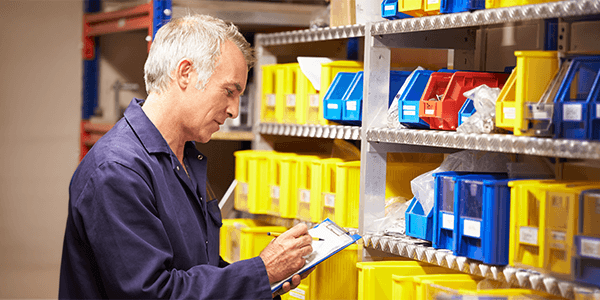
Without safe working practices, you cannot run an efficient and effective MRO storeroom, but how can you ensure safety best practice is in place and, just as importantly, followed? For RS Integrated Supply, the answer is multi-layered. It includes an operational excellence framework to regularly review performance in each storeroom alongside external accreditation, extensive training, and a culture that empowers staff to prioritize safety too. This article explores this approach to safety and its benefits for RS Integrated Supply customers beyond simply risk management.
How important is safety in MRO storerooms?
Safety is fundamental in RS Integrated Supply storerooms. “It is our main focus,” says Maria Pass, Global Lead of Compliance and Environmental Health and Safety. “Our people are our top priority, plus without safe working practices, we can’t operate effectively and efficiently, so we spend a lot of time making sure our people are safe.”
Safety is also fundamental to the package that RS Integrated Supply offers customers, says Brandon Coombs, who is Senior Vice President of Operations for North America and was named a 2026 Pros to Know by Supply & Demand Chain Executive. “Customers hire us to give them the best process experience,” he states. “They ask us to deliver as much value as we can and, while it’s not a one-size-fits-all approach, that requires us to have efficient, standardized, and robust standards and processes – including a critical focus on safety. It is by replicating these best practices that we drive value for our customers.”
RS Integrated Supply’s operational excellence framework plays a key role in the replication of best practices by ensuring consistently high standards in all storerooms. Each client storeroom undergoes an internal audit review of performance across more than 150 data points, including a heavy emphasis on health and safety, with questions about procedures, processes, equipment, training, and support. When improvement is needed, an action tracker with measurable targets is put in place and more frequent reviews follow.
Crucially, as Coombs notes, “The operational excellence framework is more than just an assessment. It builds our maturity level in terms of safety processes and drives the behaviors that we expect, helping our highly decentralized workforce to follow the highest standards of safety excellence.”
How do you ensure compliance with different health and safety legislation?
This decentralized workforce operates in regions covered by different health and safety legislation, so Pass and her team have a system in place to ensure all relevant regulations are adhered to. “We use formal legal registers that we update frequently to make sure we’re following the correct legislation and regulation that is applicable in different locations,” she explains.
Staff training is also tailored to meet the different requirements in different jurisdictions. “In the UK, for example, we have COSHH [for hazardous substances] so our people receive COSHH training. In the US, it is very similar legislation, but still our people need different training to make sure we’re meeting all the criteria and keeping everyone safe.”
RS Integrated Supply also strives to go beyond the minimum standards required by legislation, recently securing ISO 45001 accreditation. This international standard for occupation health and safety management systems, designed to prevent work-related injury and illness, was an important target, says Coombs.
“The ISO 45001 accreditation for occupational health and safety is a goal we’ve been pursuing as the next piece in our safety management system,” he states. “I’m pleased with the progress we’ve made on that.”
It’s also welcome recognition of the efforts made in this area, adds Pass: “Given that this accreditation is difficult to achieve, it shows our processes and procedures are proving to be beneficial. They are working.”
What other strategies help to ensure high safety standards?
External verification of standards is not, however, the end of the road. “We cannot rest on our laurels,” says Pass. “Safety is an always-on issue, and we are always looking for ways to improve.
“We continue to focus on the information we’re given, from near misses, employee feedback, and accidents or incidents that do happen, and try to learn from this. We try to be proactive, not reactive, and are constantly trying to find ways of getting ahead of anything that might happen.”
Training is important here too. As well as helping to ensure legislative compliance, or the use of certain procedures across all sites, training has a broader role in supporting storeroom safety. “It gives you the foundation of how you should work in the best way to keep yourself safe,” says Pass. “But just as powerful as the actual initial training are the repeated smaller pieces of information that you give. These can be impactful.”
“Take our toolbox talks,” she continues. “These are a short, around five minutes. Managers pick a subject that’s relevant and do a few slides to share with their team, followed by a discussion. These bite-sized bits of information are a good way to start the working day in our stores and the operational excellence framework gauges that these are happening.
“Safety moments are even shorter. These can be like a one-pager reminder to get out of your seat every 30-minutes and stretch that we have dotted around the offices as well as the stores.”
How do you ensure that safety is always a priority?
All these strategies – from the operational excellence framework to external accreditation to the different types of training – build on a strong cultural foundation. “The most important thing is culture,” observes Pass. “The culture is where people really learn. They open their eyes and look at a situation, rather than just following a check sheet or a procedure, and think ‘Could that potentially hurt me today?’ What am I going to do about it? Am I going to remove myself from the situation or add a different piece of PPE?’ It’s about empowering people to speak up and own that responsibility for safety for themselves.”
“Without people wanting to keep themselves and their colleagues safe, all the training and checks mean nothing,” she adds. “We can have all the procedures in the world but getting people to follow them is the important thing.”
Coombs agrees that culture is key. “If they find themselves in a situation with a safety risk, do people feel empowered to raise their hand and speak up?” he asks. “That’s the core of it: the psychological safety that drives the right behavior. We want people to feel that way, to stop the work if it’s unsafe.”
This culture doesn’t exist in the storeroom alone. It starts at the top, believes Coombs: “We want that connection with our frontline staff because we need to support them in confronting these challenges. It’s all part of the trust within the teams, and trust between management and the storeroom teams.”
Is it worth the risk?
These safety strategies and a safety-first culture are crucial for supporting safety in MRO storerooms where an emphasis on speed, getting items quickly, can – however inadvertently – encourage risk taking or shortcuts.
“There will always be another critical part that’s needed quickly but we drill into our people that we want them to slow down,” concludes Pass. “We need to get tasks done in a certain amount of time but not rush so much that it’s going to get you injured. A lot of toolbox talks, and safety moments, focus on taking a step back and thinking is this worth risking yourself for? While we want to do the best for our clients, our people are always our top priority, even if that means a task takes a couple of minutes more.”
Frequently Asked Questions
Safety is the foundation of efficient and reliable MRO storeroom operations. Safe working practices help reduce injuries, improve productivity, support inventory accuracy, and create a more effective environment for both storeroom teams and customers.
A structured operational excellence framework, regular audits, measurable performance reviews, and standardized processes can help ensure consistent safety standards across sites while identifying opportunities for continuous improvement.
Training provides employees with the knowledge and awareness needed to recognize hazards, follow procedures, use equipment correctly, and maintain a safe work environment. Ongoing reinforcement through toolbox talks and safety reminders helps keep safety top of mind.
ISO 45001 is an internationally recognized occupational health and safety standard that helps organizations establish robust safety management systems, reduce workplace risks, and drive continual improvement in safety performance.
Compliance helps organizations meet regulatory requirements, but a strong safety culture goes further by encouraging employees to actively identify risks, speak up about concerns, and prioritize safety in everyday decisions.
Leading organizations balance speed and safety by establishing clear procedures, providing regular training, promoting hazard awareness, and empowering employees to pause work if conditions are unsafe. The goal is to maintain operational performance without taking unnecessary risks.
Strong safety programs can help reduce incidents, improve employee engagement, support regulatory compliance, enhance operational consistency, and contribute to long-term MRO supply chain performance.